For HOA & Condo Association Boards

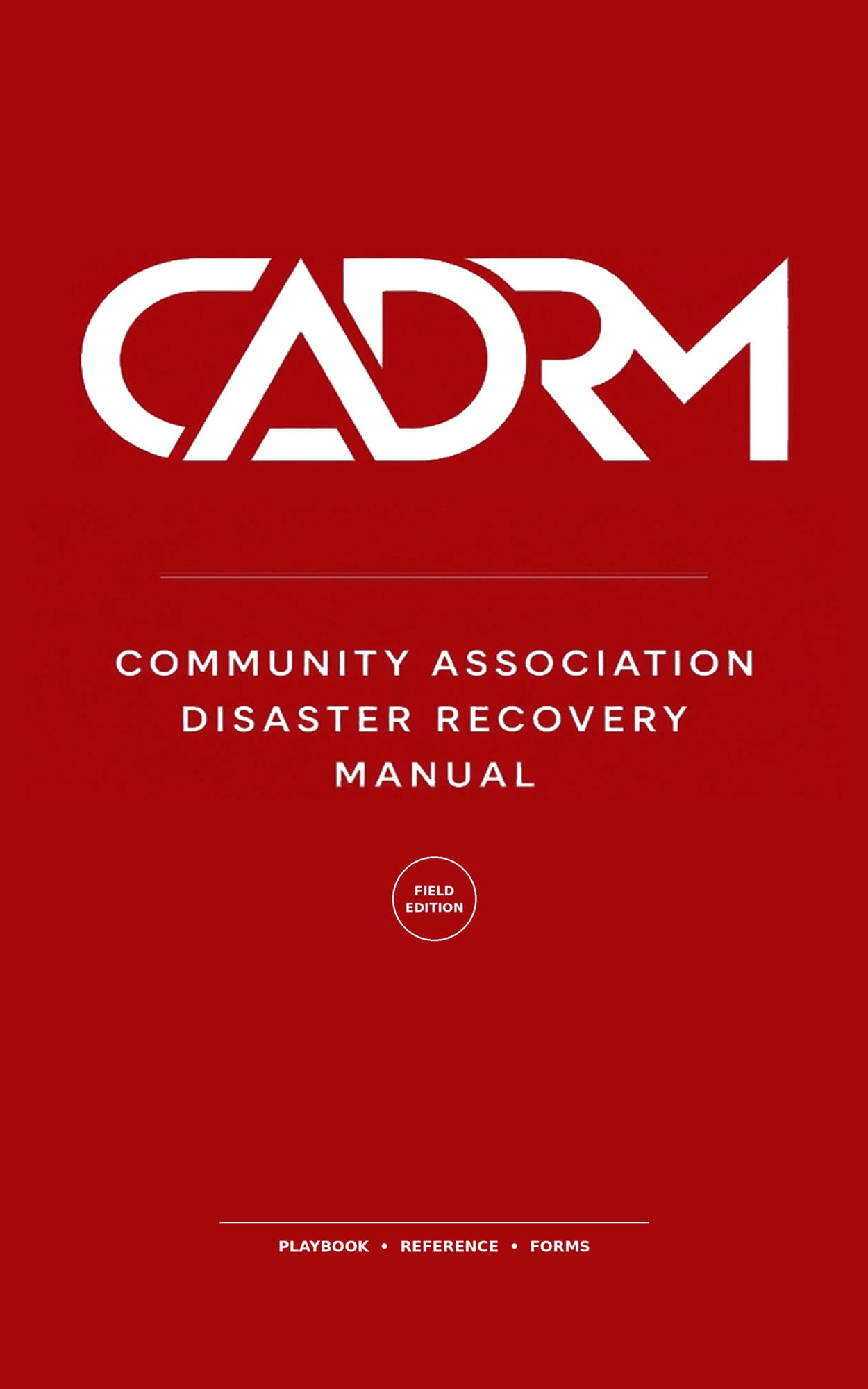
The Community Association Disaster Recovery Manual

A 206-page playbook that walks your board through every phase of recovery — from the first 72 hours through final settlement — written by a licensed general contractor and public adjuster who has settled thousands of claims.

View Table of Contents
Instant digital download
Board-ready templates
One-time purchase

46 Board-Ready Forms

Forms A–AT cover every stage: emergency authorization, notice of loss, moisture logs, deductible tracking, scope review, close-out, and more.

Every Role Defined

8 sections explain exactly what the board, CAM, broker, attorney, carrier, public adjuster, engineers, and contractors each do — and don't do.

Field Playbook Inside

Open it first. DO/DON'T in the first week, a full claim lifecycle, negotiation discipline, and a stage-gate checklist — built for pressure.

Florida-Focused Depth

Named-storm deductibles, NFIP vs private flood, Pre/Post-FIRM lower-level limits, AOB rules, and Florida statutory emergency powers — all addressed.

Full Table of Contents

Every Page, Mapped Out

48 sections across 6 parts, a full Field Playbook, 46 board-ready forms, case illustrations, and an expanded glossary.

Front Matter & Field Playbook

  • Mission · Author's Introduction · Guiding Philosophy
  • For First-Time Board Members — Start-here path, cash flow, owner politics
  • Field Playbook — First hours DO/DON'T, claim lifecycle, negotiation discipline
  • Insurance-Ready Estimates & Contractor guidance

Part I — Understanding Your Professional Team

  • Section 1 · The Board's Role
  • Section 2 · The Property Manager's Role
  • Section 3 · The Insurance Broker & Agent
  • Section 4 · The Association Attorney
  • Section 5 · The Insurance Carrier
  • Section 6 · The Public Adjuster
  • Section 7 · Engineers & Consultants
  • Section 8 · Contractors

Part II — Governance, Communications & Insurance

  • Section 9 · Fiduciary Responsibilities
  • Section 10 · Emergency Decision-Making
  • Section 11 · Board Documentation & Record-Keeping
  • Section 12 · Resident Communications
  • Sections 13–15 · Understanding Insurance · Reading the Policy · Declarations
  • Sections 16–18 · Deductibles · Replacement Cost · Recoverable Depreciation
  • Sections 19–22 · Coinsurance · Ordinance or Law / ICC · Flood · Business Income

Part III — Emergency Response & Claim Start

  • Section 23 · Notice of Loss & Duties After Loss
  • Section 24 · Emergency Mitigation
  • Section 25 · Claims Process Overview · Negotiation Discipline · Form W-1

Part IV — Claims Management

  • Section 26 · Working with Adjusters & Public Adjusters
  • Section 27 · Engineers & Expert Consultants
  • Section 28 · Scope of Loss & Estimating (Insurance-Ready / Xactimate)

Part V — Contracts, Construction & Funding

  • Sections 29–31 · Contract Review · Selecting Contractors · Payments & Depreciation Release
  • Sections 32–34 · Matching · Supplements · Appraisal
  • Sections 35–38 · Close-Out · Assessments & Funding · Betterment · Working with Management
  • Sections 39–41 · Post-Claim Renewal · Lessons Learned · Maintaining Readiness

Part VI — Counsel, Records, Readiness & Reference

  • Sections 42–45 · Legal Counsel · Record Retention · Common Pitfalls · How to Use This Manual
  • Sections 46–48 · Form W-1 Workflow Checklist · Disclaimers · Closing Thoughts
  • Expanded Glossary for Board Members
  • Case Illustrations — Documentation failures, flood surprises, PA timing

Appendix — Forms Library (Forms A–AT)

  • Emergency Vendor Worksheet · Mitigation Review Checklist · Daily Moisture Log
  • Limited Emergency Authorization · Notice of Loss · Duties After Loss Tracker
  • Deductible Funding Worksheet · Recoverable Depreciation Tracker · Scope Review
  • Contract Review · Claim Payment Tracker · Depreciation Release Checklist
  • Insurance Coverage Summary (AT-W / AT-F) · Annual Readiness Checklist

Free Sample · From the Field Playbook

When the Association Has a Significant Loss

This is the first section boards should open. It is the operational sequence — everything else in the manual is the reference library behind it.

DO / DON'T — First Week

DO

  • • Protect life safety; call emergency services as needed.
  • • Photograph and video before major tear-out when safe.
  • • Place all potentially responsive carriers on notice — property, wind, and flood.
  • • Authorize reasonable mitigation in writing with scope limits.
  • • Open a claim diary the same day.
  • • Use one board-authorized point of contact for vendors and adjusters.

DON'T

  • • Wait for the adjuster before stopping active water or board-up.
  • • Sign AOBs, blank authorizations, or financing documents under pressure.
  • • Let multiple directors give conflicting instructions to contractors.
  • • Promise owners that "insurance will pay for everything."
  • • Assume the carrier's field adjuster represents the Association.

The Claim Lifecycle

The manual uses this line at every board meeting: state the current stage in one sentence so every director knows where the claim stands. The full lifecycle runs:

Event → Notice → Mitigate & Document → Inspect → Scope/Estimate → Negotiate & Pay → Repair → Close-Out → Renew & Lessons

Negotiation Discipline (Short)

Negotiate from the file — not from frustration. One board voice. Separate scope from price. Use comparable line-item detail. Confirm calls in writing. Do not guess coverage. Do not sign releases or "full and final" language on large dollars without review. The first payment is often not final — log ACV/RCV and supplements.

⚠ Red Flag: Never sign T&M without itemized invoices, or lump-sum without a line-item scope. Never comingle wind and flood payments to a contractor without a payment log by policy. Those errors can make depreciation recovery and full reimbursement impossible.

Continue Reading — All 206 Pages

This excerpt is just the start. The full manual walks your board through every remaining step — adjuster inspections, proof of loss, appraisal, and final closeout.

Lead Your Community Through Recovery with Confidence

One purchase. One board-ready playbook. Instant download so your association is prepared before the next storm is named.